
Reading time: 10 minutes
Table of Contents
«It smells good!» «What is that smell already?» «It smells like when I was little!" »… When it comes to describing a scent, words often fail us. This subtle exercise indeed requires precise vocabulary, rigorous methodology, but also knowledge and training. Since 1983, Cinquième Sens has established itself as a pioneer in the teaching of olfaction, with training allowing everyone, amateurs and experts alike, to master this complex art of describing a scent or a perfume. Here are the basics!
The basics of describing a perfume
Those who have already Created and marketed a perfume They know this: every fragrance is a complex olfactory composition, structured around three “notes”: the top notes, the heart notes, and the base notes.
In order to describe them as accurately as possible, we first need to learn to distinguish them properly at first glance!
Understanding the structure: notes of head, heart and base
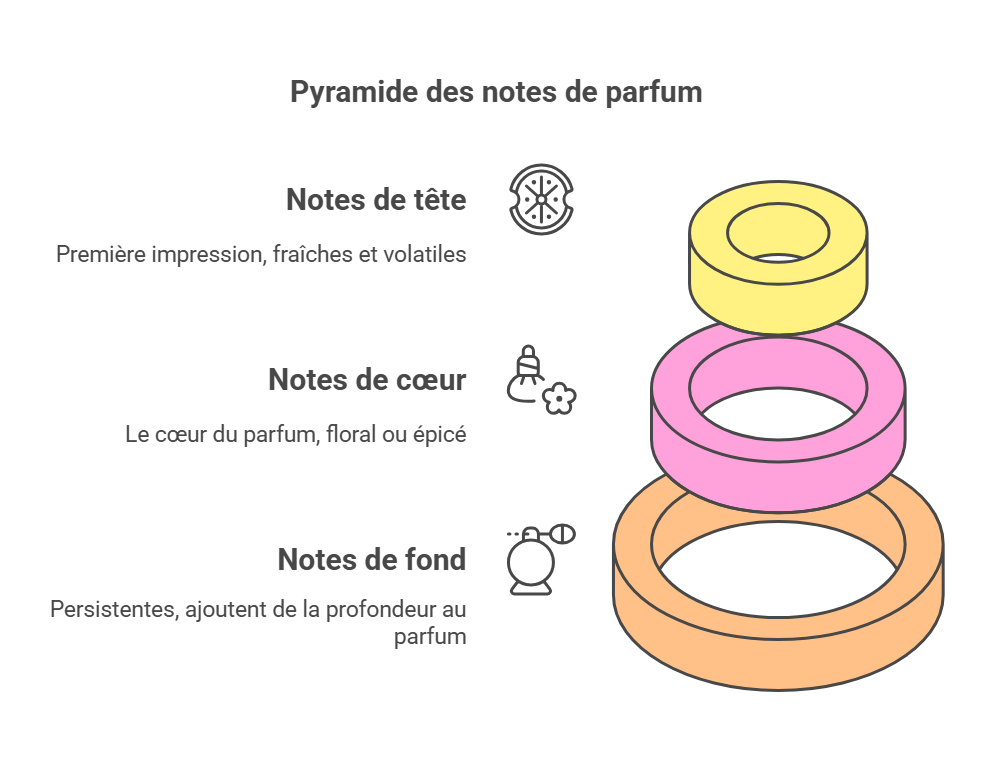
Each fragrance is defined according to its olfactory pyramid: a key representation for understanding and describing it. It distinguishes three levels or “notes”:
- Top notes Fresh and volatile, they make a first impression and disappear within a few minutes (e.g., citrus fruits like bergamot).
- Heart notes They are the heart of the perfume, unfolding over several hours with floral or spicy aromas (e.g., rose, jasmine).
- Background notes These are the ones that last the longest on the skin; they give the perfume its staying power thanks to woody or amber elements (e.g., patchouli, vanilla).
The essential vocabulary for describing a perfume
A herbaceous, floral, woody, spicy or oriental fragrance? An opulent, warm, fresh, sweet, elegant or powerful fragrance?
Understanding a scent is one thing; expressing its specifics and nuances is another. To translate an emotional feeling into technical terms as subtly and precisely as possible, it is essential to master the vocabulary of perfumery. Here are some adjectives associated with the other senses, which will allow you to define the characteristics of a scent, just as a professional perfumer would.
The words of touch
A texture: firm, smooth, fine, soft, gentle, tender, sharp, thin, flat, heavy, rough, rough, velvety, grainy, rough, oily, sticky, dry, hot, cold, soft, fragile, full, sticky, thick, round...
The words of the ear
A sound: muffled, clear, grating, intense, watery, weak, grave, violent, deafening, loud, deep, discordant, shrill
The words of taste
A flavor: sweet, sweet, bland, acidic, sour, spicy, sparkling, strong, bitter, salty, raw
The words of sight
A vision: clear, transparent, luminous, dark, clear, dirty
The words of the sense of smell
A smell: bossy, persistent, acrid, fetid, nauseating
Training in the language of smells: mastering the words of perfume
In order to best navigate this particular glossary and help you grasp and express the structure and olfactory identity of perfumes, the training «Introduction to perfumery and the language of smells» by Cinquième Sens offers a playful and theoretical approach, including the discovery of the 8 olfactory families and the first steps with the raw materials.
Mastering olfactory families and identifying the notes
Are you starting to master the basics and the main words of perfume? It’s time to take it a step further and start learning to classify scents by family and recognize the main ingredients that make them up.
The 7 major olfactory families and their characteristics
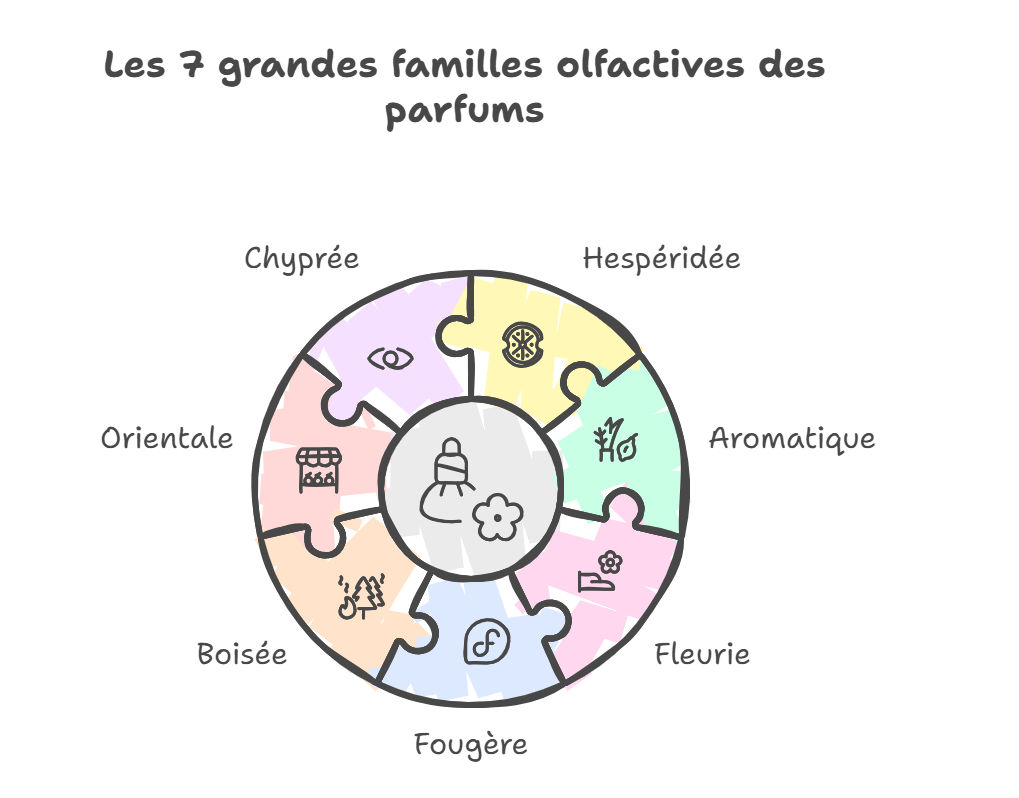
Cinquième Sens classifies perfumes into 7 major olfactory families.
- Hesperidéa
- Recurrence : lively and sparkling freshness, evoking bright citrus fruits. They often evoke the morning, dynamism and energy.
- Main raw materials : citrus notes such as lemon, orange, bergamot, orange and grapefruit.
2. Aromatic
- Recurrence Refreshing, light, herbaceous notes reminiscent of the Mediterranean countryside. Evokes nature, simplicity and a wild spirit.
- Main raw materials lavender, thyme, rosemary, sage, and basil.
3. Fleurie
- Recurrence Sweetness, femininity and romance, often associated with delicate floral bouquets.
- Main raw materials rose, jasmine, ylang-ylang,
violet, Muguet andiris.
4. Fougère
- Recurrence Timeless elegance and masculine sophistication, often used in men's perfumes.
- Main raw materials lavender, oak moss, geranium, and coumarin.
5. Forested
- Recurrence Heat and depth, often linked to natural, soothing atmospheres.
- Main raw materials Cedar, sandalwood, vetiver, patchouli, and guaiac wood.
6. Eastern
- Recurrence Opulence and sensuality, evoking exotic, enveloping scents and distant lands.
- Main raw materials Vanilla, amber, resins, spices like cinnamon and cloves.
7. Cyprus
- Recurrence Classic elegance and sophisticated sophistication, often used in intense perfumes.
- Main raw materials Oak mousse, bergamot, patchouli, and labdanum.
To recognize them, it is essential to regularly train your sense of smell with the various raw materials, whether natural or synthetic, that are included in the composition of a perfume.
The raw materials, the key to the identity of a perfume

Whether synthetic or natural, raw materials form the foundation of a perfume’s olfactory universe. Some of them have become true icons, both for their sensory richness and for their key role in creating unforgettable fragrances. Among these olfactory jewels are: rose, the jasmin, the, the bergamot and the patchouli occupy a prominent place.
- The rose Considered the queen of flowers in perfumery, it comes in many different forms, from the powdery sweetness of May rose to the fruity and honeyed intensity of damask rose.
- The jasmine Elegant and sensual, it is one of the pillars of many floral compositions. Originating from India and Egypt, its absolute brings rich and narcotic notes, often associated with luxury.
- The bergamot Essential in the production of fresh and Cologne waters, this essence with sparkling and tangy accents comes mainly from Calabria, in Italy.
- The patchouli Deep and earthy, this ingredient is an essential component of woody and oriental accords. Cultivated primarily in Indonesia, it structures and prolongs the staying power of compositions.
Link between the origin of the ingredients and their olfactory role
The geographical origin of the raw materials plays a decisive role in their quality and olfactory signature. For example, Calabrian bergamot benefits from an ideal climate and terroir to express its zesty and luminous nuances. Similarly, Indian jasmine stands out for its aromatic richness, thanks to ancestral methods of cultivation and extraction. This connection between terroir and olfactory perception imparts an authenticity and depth unparalleled to perfumes.
Training: deepening one's knowledge of raw materials
For professionals or enthusiasts wishing to go beyond the simple discovery of raw materials, the Training course «Mastery of the olfactory language» offered by Cinquième Sens This training course, lasting 4 days, offers an opportunity to explore in depth:
- 192 raw materials studied : a rich olfactory palette to understand the subtleties of each ingredient.
- 100 perfumes analyzed : to learn to identify and classify the creations of the market according to their structure and olfactory facets.
- A proven methodology : developed to refine one's perception, enrich the descriptive vocabulary and master olfactory classifications.
This immersive training helps to decipher the complex world of perfumes and to develop a true olfactory culture.
Developing your olfactory sensitivity on a daily basis
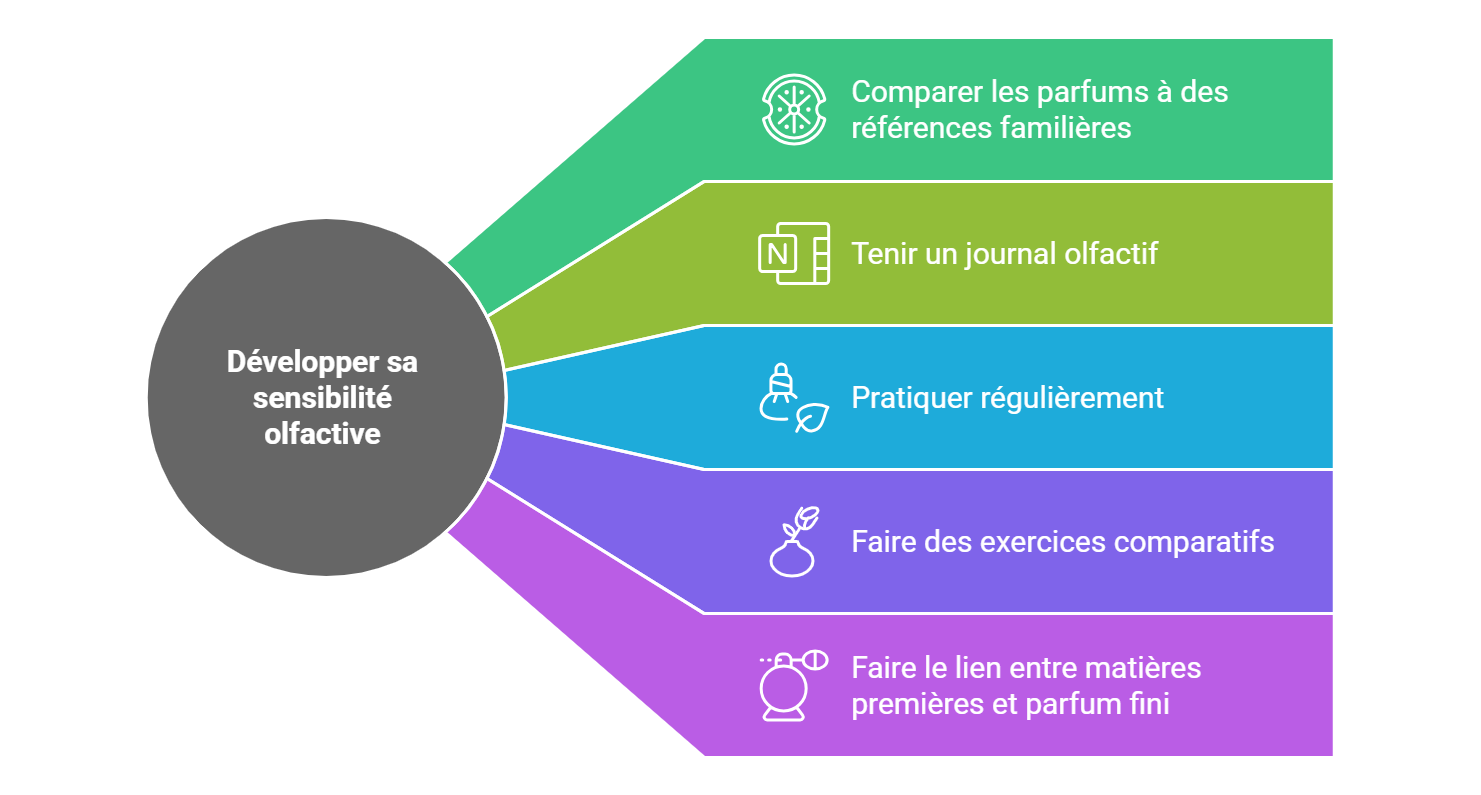
You think you know the theory pretty well and want to learn to speak like a real perfumer? For that, there’s nothing like… lots of practice! Here are some exercises and tips to exercise your nose and learn to communicate.
Practical exercises to do on a daily basis
Comparing perfumes to familiar references
An effective way to develop your sense of smell is to associate scents with everyday elements. For example, when you smell a fragrance containing bergamot, try to think of the zest of a freshly squeezed citrus fruit, in order to create a connection in your brain between that image and that scent.
Keeping an olfactory journal and recording your impressions
An olfactory journal is an excellent tool for memorizing your perceptions and building an olfactory memory bank. Every day, you should note the scents you feel: their olfactory family, the characteristics they evoke, their main facets, their personality. This practice will help you structure your observations and develop a precise descriptive language. You could, for example, record impressions such as: “A hespiridized head note, reminiscent of candied lemon, followed by a powdered floral heart.”
Practice it daily
As with any learning process, regularity is essential. Dedicate a few minutes each day to feeling and analyzing a raw material or a fragrance. Only repetition will allow you to refine your olfactory memory and gradually recognize increasingly subtle nuances.
Doing comparative exercises
A practical exercise involves comparing two brands of perfume or raw materials, such as two types of roses: May rose and Damascena rose. Observe their differences in terms of freshness, sweetness, or intensity. This will help you understand how a same olfactory family can offer varied facets.
Learning to connect the raw materials to the finished perfume
To link theory and practice, identify the raw materials that make up the perfume. For example, if you smell a perfume based on patchouli, try to recognize its role in the composition: is it used for its woody, earthy aroma, or for its fixing power? This exercise will help you better understand the interactions between the ingredients and their impact on the final result.
Describing a perfume: a skill to cultivate
In short, describing a perfume with accuracy and precision requires a skillful balance between knowledge, technique, practicality, and culture.
Cinquième Sens offers a unique accompaniment to professionals, job seekers and enthusiasts through customized training programs. These programs transform a simple olfactory perception into a true mastery of the language of smells, thus paving the way for solid and recognized expertise.
To enrich your knowledge and share your passion, we invite you to explore the available courses. They are designed to deepen your understanding of raw materials, refine your olfactory vocabulary, and perfect your analysis of fragrances.
Finally, like an artist or athlete, regular exercise is the key to maintaining and developing your sense of smell. Exercising every day, exploring new scents, and testing your perceptions are all ways to awaken and refine this essential sense of smell.