Summary
Because it comes into contact with the skin, perfume is not a product like any other. Before it is put on the market, Therefore, all perfumes must comply with numerous legal obligations., French and European regulations, in particular those issued under the European Regulation on Cosmetic Products (CE n°1223/2009).
Composition, prohibited substances, labeling rules, administrative declarations…: here is 6 important rules to know and follow before starting market his perfume.
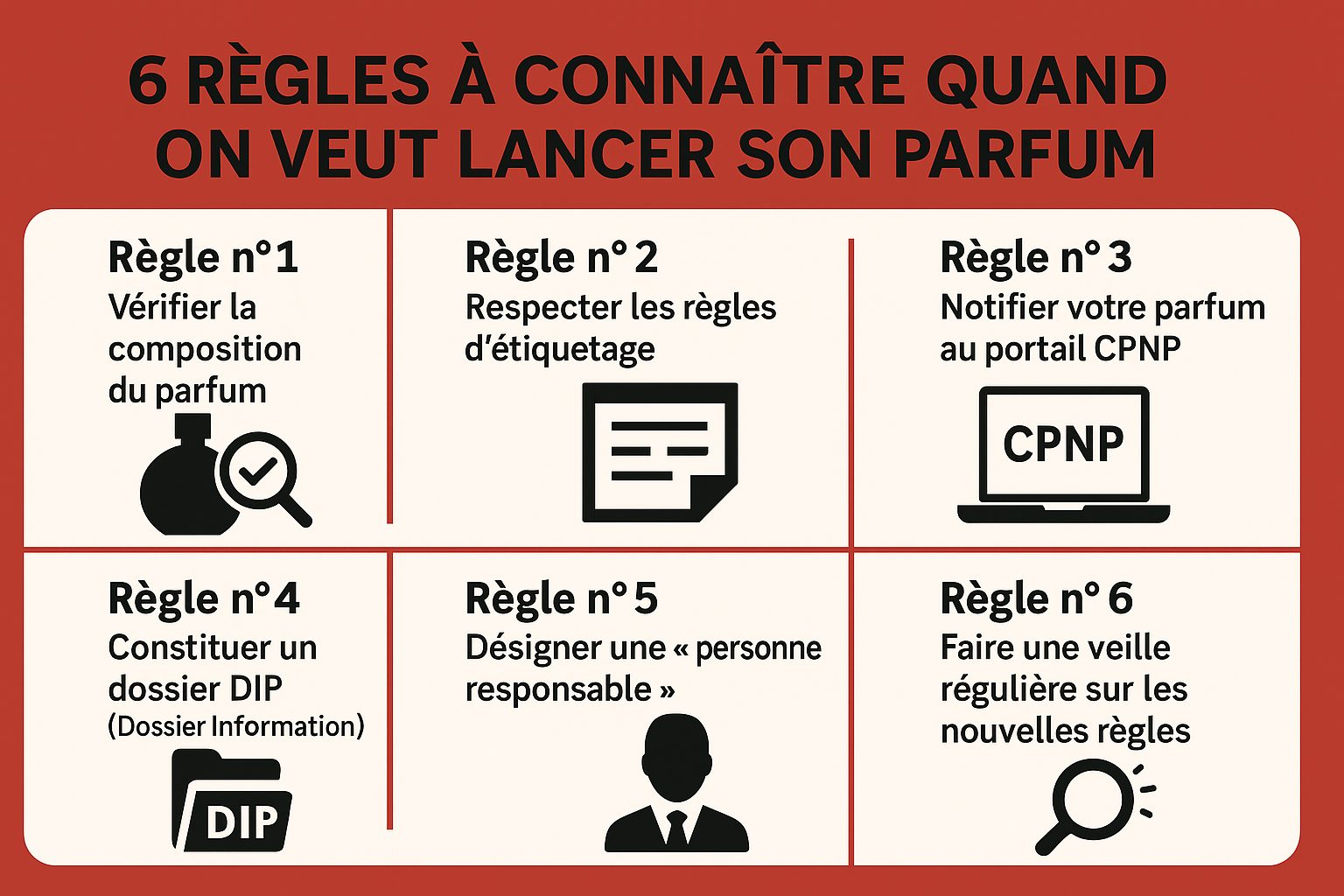
Rule #1: Check the composition of the perfume
The first regulatory obligation concerns the composition of the fragrance. The European Cosmetics Regulation (CE No. 1223/2009) prohibits or limits the use of certain substances in order to protect public health. Chemical products, colorants, preservatives… The main provisions are set out in Chapter IV of the regulation, and in particular in Article 15, which prohibits the use of substances classified as CMR (carcinogenic, mutagenic or reprotoxic) in cosmetic products.
The complete lists can be found in annexes II and III of the document:
- Prohibited substances: Heavy metals, gases, hydrocarbons, toxic chemicals… more than 1300 substances are completely prohibited. They are specified in Annex 2 of the regulation.
- Restricted substances: listed in Annex III, these substances are authorised under certain conditions only (maximum concentration, warning labels, etc.)
Before its commercialization, it will therefore be essential and imperative to check each ingredient with your supplier or the composition house, especially to ensure that no prohibited substance is included in the formula.
- Source that can be easily consulted:
Regulation EC No. 1223/2009 (EUR-Lex)
Rule #2: Follow the labeling rules
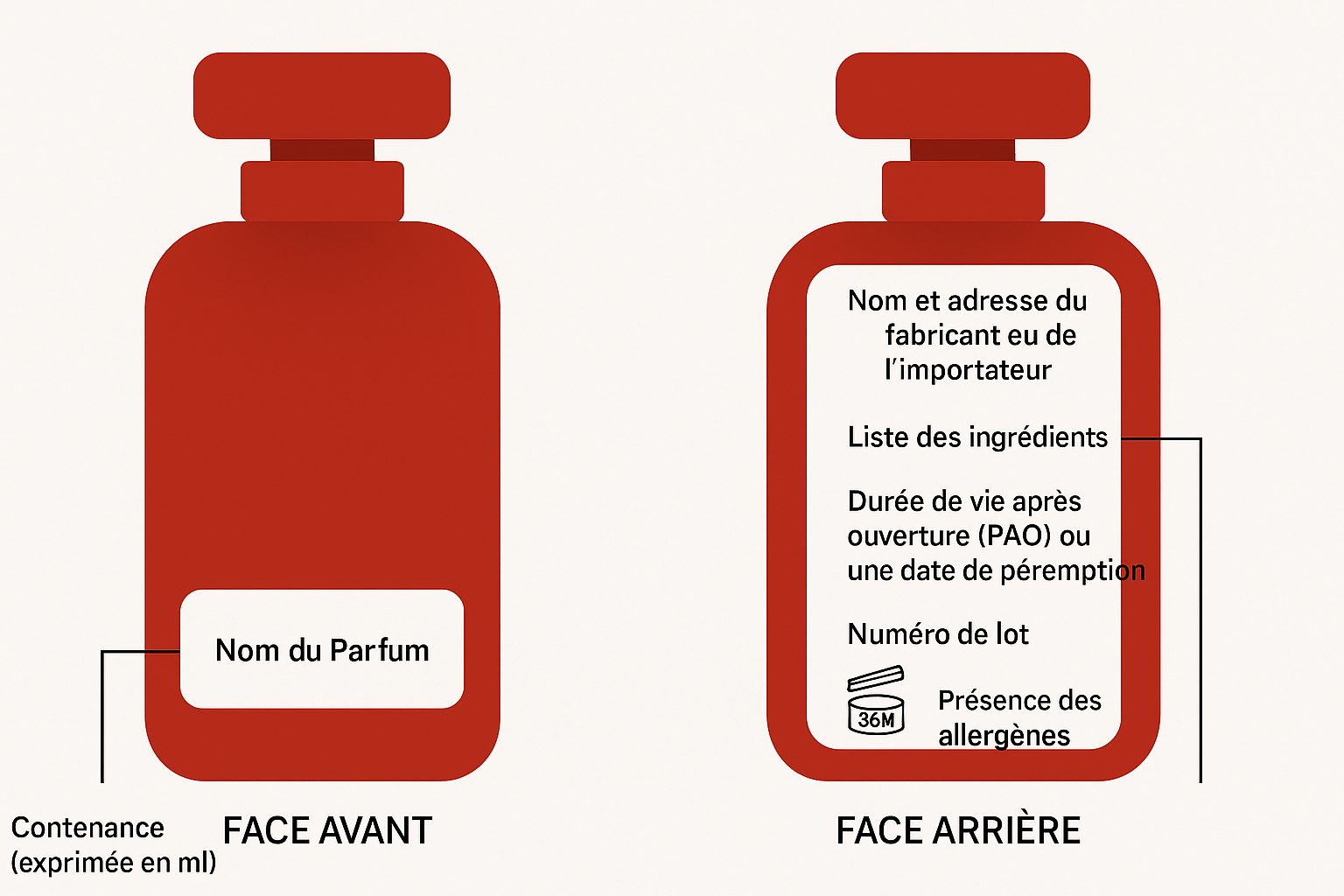
The label of a perfume marketed in the European Union must meet specific requirements. These mandatory mentions allow the consumer to be informed about the product and to guarantee its traceability.
The mandatory elements are:
- The Name and address from the manufacturer or the importer,
- The INCI list ingredients (in the international nomenclature),
- The life span after opening (PAO) or an expiration date,
- The lot number,
- The contentment (expressed in ml),
- The presence of allergens, even in low doses, Regulated (26 substances identified by the European Commission, such as limonene or linalol).
Rule #3: Notify your perfume on the CPNP portal
Provided for by Article 13 of Regulation (EC) No 223/2009, the declaration on the European CPNP portal (Cosmetic Products Notification Portal) is mandatory (and free of charge). When a product has been notified on the CPNP, it is not necessary to proceed with another notification at the national level.
You will be required to provide the following information in particular:
- The category of the cosmetic product and its name or names, in order to allow its specific identification;
- The name and address of the person responsible for the product;
- The country of origin in the case of import;
- The Member State in which the cosmetic product is to be placed on the market;
- The contact details of a natural person to contact in case of need;
- The presence of substances in the form of nanomaterials;
- The presence and the name of substances classified as carcinogenic, mutagenic or toxic for reproduction (CMR)
- The framework formulation allowing prompt and appropriate medical treatment in the event of disorders.
Useful source:
Easy guide on the CPNP portal
Rule #4: Create a DIP (Product Information File)
The DIP (Product Information File) is a key document in regulatory compliance, intended to prove that the perfume placed on the market complies with the various standards. It must be kept available to health authorities for 10 years after the product was last marketed. It must be compiled with the utmost care: in fact, an incomplete or missing DIP can lead to a recall of the product or even administrative sanctions.
This dossier includes:
- The Report on the safety of cosmetic products, written by a qualified security evaluator,
- The test results (stability, compatibility, skin compatibility, challenge test, etc.),
- The description of manufacturing process,
- The marketing claims justified (e.g.: «long-lasting», «without allergens»).
Rule #5: Appoint a «responsible person»
Every perfume that is put on the market in Europe must have a Person Responsible (PR), clearly identified. This person (whether moral or physical) has the mission to:
- guarantee compliance from the product to the CE Regulation 1223/2009,
- to ensure the traceability of the product,
- manage any adverse effects (cosmetovigilance),
- perform the Product recalls, If necessary.
She can be the manufacturer, the importer or a representative and must be listed on the packaging with her contact details. In the event of a dispute, she must be held legally liable and responsible.
Rule #6: Keep up to date with the latest rules
Like all regulations, that on perfumes and cosmetics is constantly evolving, in line with new scientific discoveries and health concerns.
Des substances What is allowed today may be banned tomorrow (endocrine disruptors, allergens…). Things that are not allowed today may be allowed tomorrow (antibiotics, hormones, etc.). Warnings can be added to certain raw materials and New labeling rules may come into effect (e.g.: extended allergens planned for 2025).
It is therefore strongly recommended to carry out regular monitoring and to subscribe to the bulletins and newsletters of the European Commission, the ANSM (France), or to follow the updates of the IFRA (International Fragrance Association).
- Easy-to-follow official sources:
DGCCRF
ANSM
The risks in the event of non-compliance?
When a cosmetic product is being marketed or when one wishes to create a perfume range, Compliance, respect of rules and standards are not options; they protect not only customers but also your business, ensuring the health and safety of everyone.
Failure to comply with them can be costly: immediate withdrawal from the market, significant fines, and, in the event of recidivism or endangerment, penalties that can reach up to 2 years in prison…
To make your life easier and to consider the commercialization of your perfume with complete serenity, Cinquième Sens offers training courses that will help you master all the regulatory aspects of launching your perfume. Contact our team or discover our professional training courses.
I am discovering the training on perfume regulations and DIP files