The opening of the Studio, a pedagogical center in the heart of the Louvre, is an opportunity to take a look at the educational and social offerings of France’s first museum, and its many patrons. Bernard Hasquenoph offers a series of two articles on the subject. Here is the second part.
Discover the first part: Social Louvre, mediation for all
To carry out its programs of mediation with schoolchildren, young people in vulnerable situations, people in great need, refugees, detainees, the sick and those with disabilities, the Louvre can count on many sponsors. A long list that is surprising because one does not find the big brands that one is used to seeing at the museum*.
Un flawless loyalty
One wonders about their specificity. «The loyalty,” Yann Le Touher, responsible for sponsorship, brand and commercial partnerships at the Louvre, replied without hesitation. Most of them are already foundations whose support focuses on educational and social initiatives. They commit for 3 or 5 years and often renew their commitment. We try to create
projects that allow for sustainability ». In this sense, the Petite Galerie opened in 2015 on the ground floor of the Richelieu wing offered an ideal opportunity. Although this space dedicated to multidisciplinary exhibitions on a cross-cutting theme in the history of art is open to everyone, it was created as a platform for artistic and cultural education initiatives.
New themed editions
With particular attention to accessibility, thanks to the support of the Handicap & Société Fund of the Intégrance mutual insurance company for vulnerable people. The education, disability and social field groups are welcomed first priority on Tuesday, the day of closure. Each edition, addressing a new theme, offers the opportunity for new workshops, storytelling and guided tours, while previous exhibitions travel to various locations, in the form of reproductions, such as a university library, a medical-social center or a shopping mall. As well as in the factory on several occasions thanks to the PSA foundation (Peugeot-Citroën), sponsor of the Petite Galerie since its opening.
This space has enabled the «crystallization» of part of the sponsorships dedicated to educational and social programs at the Louvre, according to Yann Le Touher. This was the case with the Total Foundation, which, as a sponsor of the Petite Galerie from 2015 to 2017, previously supported the Women’s Week. However, these large foundations remain dependent on the restructuring of their business.
PSA, which has become Stellantis since its merger in January 2021 with Fiat Chrysler Automobiles, its foundation, while remaining faithful to the Louvre, has suspended its 2021 call for projects, pending a redefinition of its «philanthropic line,» as its website indicates.
Internal changes
Internal governance changes can also have an impact. This is the case of the Engie Foundation, which has been a sponsor of the Petite Galerie until 2020. «We need to review them to clarify what we are going to do with them,» says Yann Le Touher.
To date, the Louvre has raised 814,000 euros in sponsorship for artistic and cultural education projects in 2021, including 350,000 for the Petite Galerie exhibitions. That is almost the same as in 2019. Others, in addition to monetary contributions, contribute more concretely to the cause. The RATP Foundation provides coaches to transport audiences, as mobility is a often overlooked obstacle to the cultural divide. The Canson brand provides drawing paper for artistic activities.
The MGEN, a historic teachers’ mutual association, distributes educational kits containing reproductions of works from the museum, primarily in isolated rural areas, through its regional branches. According to the Louvre official, this type of foundation is less demanding in terms of compensation than a traditional corporate sponsorship, often limited to internal communication and the granting of entrance fees to museums to associations that the foundations themselves support.
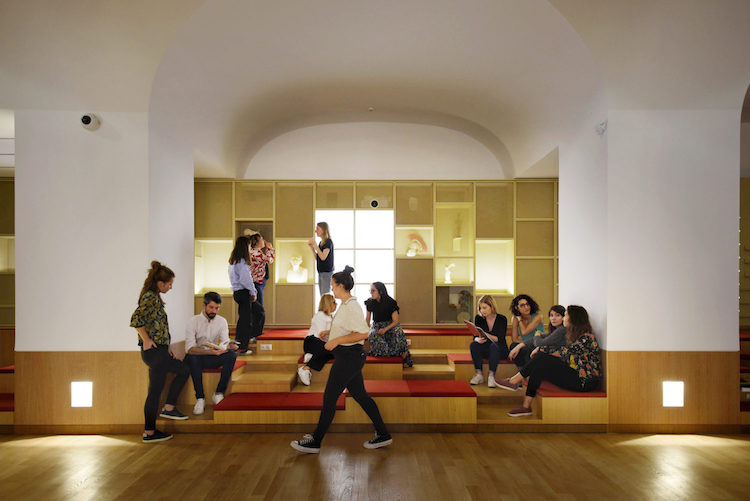
The Petite Galerie project was complemented by a 1200m2 educational center called the Studio, which took six years to complete. The adjacent rooms served as storage space. Today, they house 9 comfortable art-making workshops and training spaces (with large restrooms and an acoustically isolated room with a mirrored wall for body expression), in contrast to the 5 small rooms that were previously housed under the Pyramid. First, one must cross a gallery called the Forum, a long hall equipped with bleachers, designer seating, and large cushions on the floor.
Open to all visitors with an entrance ticket to the museum, you can sit there, consult books, do a puzzle or draw, attend readings or demonstrations, for example about the museum’s crafts… A first for the Louvre.
Association media
From Anglo-Saxon sponsorship
Another specific feature of the sponsorship of the museum’s educational and social activities is the predominance of Anglo-Saxon donors, either individually or collectively. The Studio, costing 5.45 million euros, was thus largely sponsored by American Friends of the Louvre (figure not disclosed).
«Education is one of the topics that receives the most support from cultural institutions in the United States. We knew that Americans would respond to this project,» says Yann Le Touher. Moreover, the educational centers, which are common in American museums, could have been a source of inspiration for the Louvre. The lockdown then prompted the museum’s sponsorship team to realize an idea it had been keeping in its drawer: creating an online auction for the benefit of the Studio’s activities in collaboration with Christie’s and Drouot, with the museum as the unifying thread.
Among the lots donated mainly by partners: works by artists, luxury products and exclusive experiences such as attending the annual examination of the Joconde or strolling on the roofs of the Louvre with the artist JR. «I thought, this is the right time,» the manager said. “We can reach the whole world and make the Louvre’s name shine in a different way, intelligently. It may have made some people blink, but I consider raising almost 2.4 million euros during the pandemic to be audacious.”.
The social purpose of the sale would have been motivating. The generous sum will ensure the Studio’s operation for 3 years, making its activities completely free of charge, including artistic workshops for everyone, children and adults (with the exception of dance workshops).
A unique proposal in a Parisian museum. Indifference towards public life: Jean-Luc Martinez, the president of the Louvre who initiated the project in 2015 at the same time as the Petite Galerie, did not reap the fruits of it, since he was dismissed before the opening. The visitors, yes.
Bernard Hasquenoph
* Patrons of the Louvre Museum in support of its artistic and cultural education missions for the year 2021-2022: the PSA Foundation, the Handicap & Société by Intégration Fund, Alex Taylor in memory of Anne Cox Chambers, Madame Krystyna Campbell-Pretty and the Campbell-Pretty family, as well as the Susan D. Diskin Fund within the Louvre Endowment Fund for their support of the Petite Galerie du Louvre; the American Friends of the Louvre and Avery and Andrew Barth for making the creation of the Studio possible through their generous support; the artists, the major houses and the auctioneers for their generous support for the Studio through the «Bid for the Louvre» auction. TOTO for making it possible to equip the restrooms; the RATP Group Foundation for its support of the public in the social field; the Elahé Omidyar Mir-Djalali Fund, within the Louvre Endowment Fund, for its support of the public in the social field; the MGEN for its support of artistic and cultural education programs in schools; the Crédit Agricole Solidarity and Development Foundation with the Crédit Agricole Brie Picardie Mécénat et Solidarité Endowment Fund and the Orange Foundation for their support of the Le Louvre in Prison program; the Frédéric Jousset Fund, within the Louvre Endowment Fund, for its support of the Le Louvre in Prison program; Agon Shu for his support of accessibility; Norline & Cinquième Sens, partners of the museum’s mediation tools; Canson for its support of the museum’s art practice workshops; Olalar, the magazine for young art enthusiasts aged 4 to 7, partner of «La boîte à histoires».