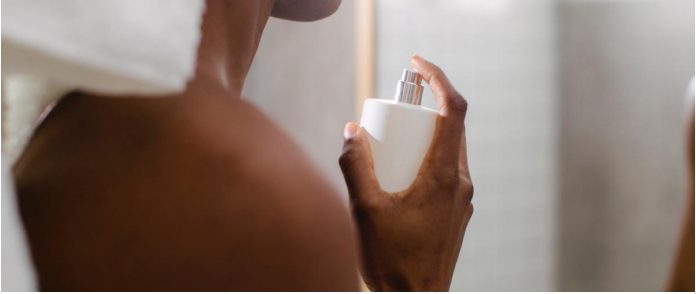
Why do we no longer smell our own perfume after a certain time?
Getty Images
The nose can play tricks on us. A perfumer and an olfactory expert explain why our noses
Our perfume is no longer detected a few hours after application.
This may come as a surprise: a colleague or friend may compliment us on our work during the day.
the smell of the perfume that we exude, while we ourselves no longer sense it for several hours. It is
Indeed, it is quite possible that our own nostrils no longer detect the fragrance applied, yet
Sometimes in large quantities the same morning, but we still have to get rid of it. How can we explain it?
Is it the quality of the perfume? Its composition? The pH of the skin?
Why do we no longer smell our own perfume?
A matter of habit
In reality, the main reason is simply habit. Like all the senses, the sense of smell gets used to things. In fact, we still sense things, but the information is no longer processed by the brain. Isabelle Ferrand, an olfactory expert for the Maison Cinquième Sens, explains: «At the base of our nasal cavity, at the level of the sinuses, we have a filtered olfactory mucosa of receptors. When an odorant molecule reaches it, the information is transmitted to the brain via the olfactory bulb.» Or after a while, the smell becomes part of our daily life, and the brain decides to no longer pay attention to it. «You don’t become anosmic, but you no longer process the information,» the specialist explains.
The environment at stake
Several external factors can influence our perception of smell. In general, it is first necessary to know that we smell better in the morning, for example. «It’s a matter of saturation: in the morning, the nose is empty of any odor molecules,» comments Aliénor Massenet, perfumer for Symrise. As a general example, the specialist usually waits until Monday morning to validate the production, knowing that his nose will be more receptive than on Friday afternoon. «Humidity, outdoor temperature, mood, or even hormones can make it so that one smells better or worse,» the professional adds.
The outside temperature, mood, or hormones can make one feel more or less the scent of alienor massenet, a perfumer. A current of air during the day, or the one produced during movement, for example, also creates ventilation allowing the odor molecules to diffuse again.
The quality of the perfume
The composition of the product, its scents, also play a role. «If the fragrance is predominantly composed of top notes (those that are felt first when vaporized), very volatile, the odor molecules will disperse very quickly. On the other hand, if it is composed primarily of base notes, the evaporation is less significant, and the scent can remain until the next day,» informs Isabelle Ferrand.
If the fragrance is composed primarily of top notes, the odor molecules will disperse very quickly. Isabelle Ferrand, an expert in olfactory analysis: «The citrus notes, such as orange, lemon, bergamot or mandarin, will evaporate very quickly.» “The scent of the floral family of notes can persist for up to 5 hours, and that of the amber family can last up to three days,” Aliénor Massenet adds. Here’s why Cologne waters and eau de toilette, whose composition primarily includes citrus notes, evaporate more quickly than perfumes.
How to preserve the scent? The solution to re-sense its fragrance is to spend a few days without wearing it, or to alternate with other products. You can either change the product, or temporarily replace it with the same one, but with different concentrations: eau de toilette, extracts, complementary products such as shower gel…
However, nothing is fatal. Isabelle Ferrand’s conclusion: «When you no longer sense it, it means that it is part of you, that it is in harmony with you. It is your perfume.».
Find us on: https://madame.lefigaro.fr/
Article written by: Kassandre Fradelin